

Last Updated: April 2026
As the days grow colder, keep the following issues in mind when considering winter pond care. First, your fish need a pond depth of at least 18-24” or more in order to successfully hibernate. If your pond does not meet this depth requirement, you will need to find or create new quarters for them to live in during the winter months. Refrain from feeding your fish once temperatures drop to 50ºF and lower. You’ll want to avoid any metabolic complications as they get ready for hibernation.
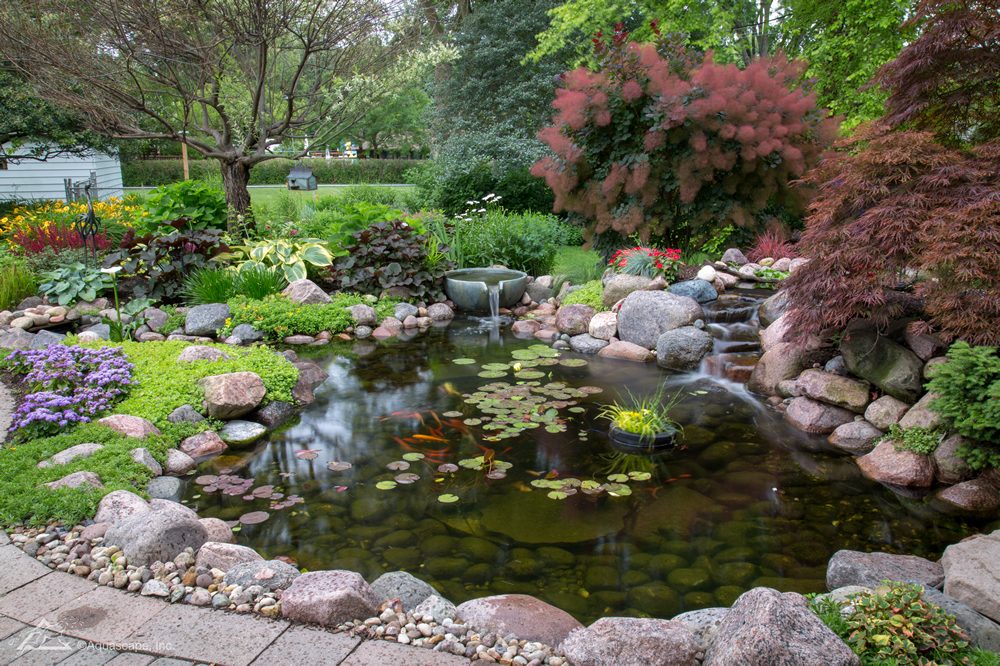
If your pond is susceptible to freezing over in your area, for the sake of your finned friends, be sure to check that the pond water stays oxygenated. An easy way to aerate the water and ensure a successful hibernation for your fish is to keep your waterfall running throughout the winter. As a bonus for choosing to keep your waterfall running throughout winter, you’ll get to enjoy amazing ice sculptures! Many pond owners opt to utilize this option, but it is not required. Winter pond care can go with or without a running pond.
It is likely that some of the pond water will evaporate during winter if you leave the falls running. Although water loss is considerably less in the winter than it is in summer, you may find yourself needing to add water at some points throughout the season. You can also check to make sure an ice dam isn’t causing water to trickle out of the pond.
If you do decide to shut down your waterfall(s) for the winter, unplug the waterfall pump, remove it from the pond or skimmer, and then store it in a location that will remain frost-free. In lieu of a running waterfall, you can place a pond aerator or a submersible pump on the second shelf of your pond. Make sure to place it so it bubbles right at the surface of the water. So long as your winter temperatures are not drastically frigid, the bubbling of the pump should be enough to keep an open hole in the ice. This will help to ensure the health of your fish, as keeping a hole in the ice allows potentially harmful gasses to escape.
You’ll want to add a floating de-icer if your pond is liable to freeze over. The unit utilizes a thermostat so that it only runs when the water temperature is at or below freezing, heating only the immediately surrounding water to just above that, and then shutting off again. For those located in the more northern areas of the country, the best-recommended solution is to implement a combination of a small pump and de-icer.
Bonus: Enjoy the Beauty of Ice!
Some of the most spectacular winter sights this season may form right in your own garden. A frosty waterfall presents the perfect conditions for snow and ice formations. Take time to enjoy the peaceful and quiet splendor of your snowy garden. These winter months are the perfect time to rest and recover from a bustling summer full of activities. Relax as you anticipate the emergence of pond life when warmer days roll around once again.
Frequently Asked Questions
- Do I need to bring my koi inside during an Illinois winter?
- No — koi can overwinter outdoors in the Fox Valley as long as the pond is at least 3 feet deep and does not freeze solid. Koi go into a torpor state below 50°F and require very little oxygen, but they do need some open water for gas exchange. A pond heater or aerator positioned near the surface maintains a small opening in the ice and is typically all that is needed for Oswego and Yorkville winters.
- What happens to my pond fish if the water freezes completely?
- A completely frozen pond is dangerous and can be fatal to fish. As ice covers the surface, toxic gases from organic decomposition build up beneath it with no way to escape. Even a few days under a solid ice sheet can cause significant fish loss. This is why a pond aerator or deicer is essential during Fox Valley winters — preventing a complete freeze is far easier than trying to break ice safely without harming fish.
- When should I stop feeding my pond fish in the fall in Illinois?
- Stop feeding koi and goldfish when water temperatures consistently drop below 50°F — typically late October to early November in the Oswego and Yorkville area. Fish metabolism slows dramatically in cold water and they cannot digest food properly, which leads to waste accumulation and water quality problems. Switching to a wheat germ-based food in early fall before stopping entirely is a good transition strategy.
Related Resources: Pond Maintenance in Fox Valley | Water Features | Contact BLC Yardworks
Written by BLC Yardworks — Fox Valley hardscaping, landscaping, and water feature contractors serving Oswego, Yorkville, Plainfield, Naperville, and surrounding communities since 1999.